
February 24, 2026
by Daniel Vesecky
Charter schools are publicly funded, privately operated schools that provide alternatives to neighborhood public schools for Chicago students and families. They are intended to offer families more choice through specialized and innovative approaches to education, with many offering specific curricula, such as STEM, or catering to certain student populations, such as English Language Learners. Chicago’s landscape of charters includes large networks of over a dozen schools as well as single-school institutions.
The Chicago Public School District (CPS or the ‘District’) has 108 charter schools, which in 2025 accounted for an enrollment of 50,326 students. The total 2025 enrollment for CPS was 325,305 students, approximately 16.1% of whom were enrolled in charters. In its 2026 fiscal year, CPS will directly spend approximately $948 million on funding charter and contract schools, almost a tenth of the total CPS budget and over 17.5% of all direct school funding.
With charters playing such a major role in Chicago Public Schools, it is important to understand how they are funded.
State-Mandated Minimum Funding
State law defines the minimum funding for each charter school through a formula known as the Per Capita Tuition Charge (PCTC). Originally defined to determine the tuition rate a school district should charge to a nonresident student, PCTC is calculated by totaling operational and debt spending for a school district, subtracting funding received from state or federal sources, and dividing by the district’s average attendance rate. In FY2026, CPS’ PCTC was calculated to be $20,352.85.
State law mandates that all school districts contribute between 97% and 103% of their PCTC to charter schools for each student enrolled in the school. At a minimum, CPS is thus required to contribute 97% of its full PCTC of $20,352.85 to each of its charter schools in FY2026. This comes to $19,742.27 per enrolled student.
CPS has seen its PCTC grow significantly over recent years. In 2015, PCTC was approximately $12,229. Between 2019 and 2024, the District’s PCTC figure jumped by over $5,000—or by a full third of the 2019 minimum.
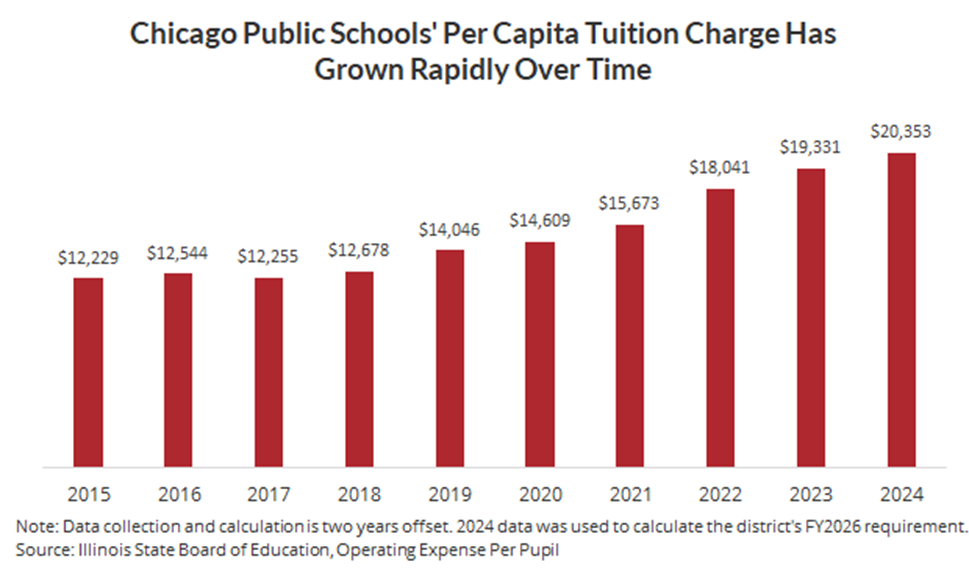
Since PCTC is directly tied to the District’s operating costs per student, charter school funding increased significantly over the past decade as CPS saw its total spending increase sharply during the COVID-19 pandemic, rising by nearly 50% between FY2018 and FY2022. During this period, CPS used federal funding to hire thousands of new staff. Concurrently, district-wide enrollment continued to decline. This led to a higher overall cost per student within CPS, which commensurately increased its PCTC contribution requirements for charter schools.
CPS Charter Funding Policy
CPS’ policy on charter funding has changed several times in recent years. In FY2025, CPS completed a transition away from student-based budgeting (SBB), which allocates funding to schools based on their total number of students. Since 2014, CPS has used SBB to determine funding for both charter schools and network schools. Once SBB was phased out for network schools in FY2025, the District also eliminated it for charters.
SBB was replaced with the core instructional funding (CIF) formula for neighborhood schools, and charters received a per-pupil stipend that was equivalent to the average per-pupil funding for network schools. In addition to CIF funding, charters received non-instructional funding proportionate to funding received by district schools, as well as funding for special education and supplemental funding for schools that did not rent CPS facilities.
However, this system led CPS to fall below the state-mandated PCTC minimum funding rates for some charter schools, requiring true-up payments to meet the minimums. Thus, CPS transitioned again in FY2026 to a funding model based solely on PCTC. Each charter school receives its minimum PCTC allocation, less deductions for pension and debt obligations. This single lump sum replaces the CIF, non-instructional, special education, and facilities funding introduced in 2025.
As noted above, CPS, like all school districts, is required to pay a minimum of 97% the district’s PCTC per charter school student, which in FY2026 is $19,742.27. CPS additionally charges a 3% administrative fee to all charter schools, reducing this number to $19,150.00 per student. However, CPS does not simply disburse this full sum to each charter school. The District itemizes a per-pupil cost of several big-picture expenses—primarily for pensions and short-term debt—that support all CPS schools (including charters).
The largest such expense is pensions. Although the State of Illinois covers CPS’ normal pension costs—the new costs accrued by employees each year—the District is required to pay down its unfunded liability, or the shortfall in funding for pension benefits accrued over time, by itself. In FY2026, the CPS contribution associated with paying down the unfunded liability to the Chicago Teachers’ Pension Fund amounted to $663.6 million. According to the district, this broke down to a per-pupil proportionate cost of $2,089.80.
Additionally, the District budgeted $23.2 million for interest payments on short-term debt in FY2026. The per-pupil share of this interest was calculated at $46.11. CPS deducts the per-pupil expenses for pension obligations and short-term debt from the PCTC payments it makes to each charter school, leaving $17,014.09 per student. The district also subtracts additional expenses for charter schools that are based in district buildings, an issue addressed in detail below.
Charter Schools in CPS Buildings
Charter schools that reside within CPS-owned buildings get a different per-pupil payout than charter schools that utilize independent facilities. Charters within CPS buildings face two major expenses. First, in addition to deducting a per-pupil breakdown of pension obligations and short-term debt from their PCTC calculations, CPS also deducts a per-pupil portion of the district’s long-term debt service obligations each year. The rationale behind this deduction is that long-term debt finances capital investments in CPS facilities, so charters that do not utilize CPS facilities should not have to pay that cost, while charters that do utilize these facilities should have to pay a share of the expense for their upkeep. This per-pupil deduction was $2,798.94 in FY2026, leaving these charters at a final PCTC disbursement of $14,215.15 per student, significantly less than their independent equivalents.
Second, in addition to the long-term debt charge, CPS charges a per-pupil fee for maintenance ($1,726.22), security ($346.19), and IT services ($94.22). CPS allows schools to opt out of the security and IT services. Schools that are the sole occupant of their facility may also opt out of the maintenance fee. The tradeoff for the long-term debt charge and the additional fees is that charter schools inhabiting CPS facilities are allowed to rent their buildings for only $1 per year. A school that accepts all maintenance, IT, and security services would net only $12,048.52 per student disbursements after all fees were subtracted from PCTC. However, such a school would then have many of its non-instructional costs covered, including rent, capital, maintenance, and security — all hefty expenses for schools based in independent facilities.
Declining Enrollment
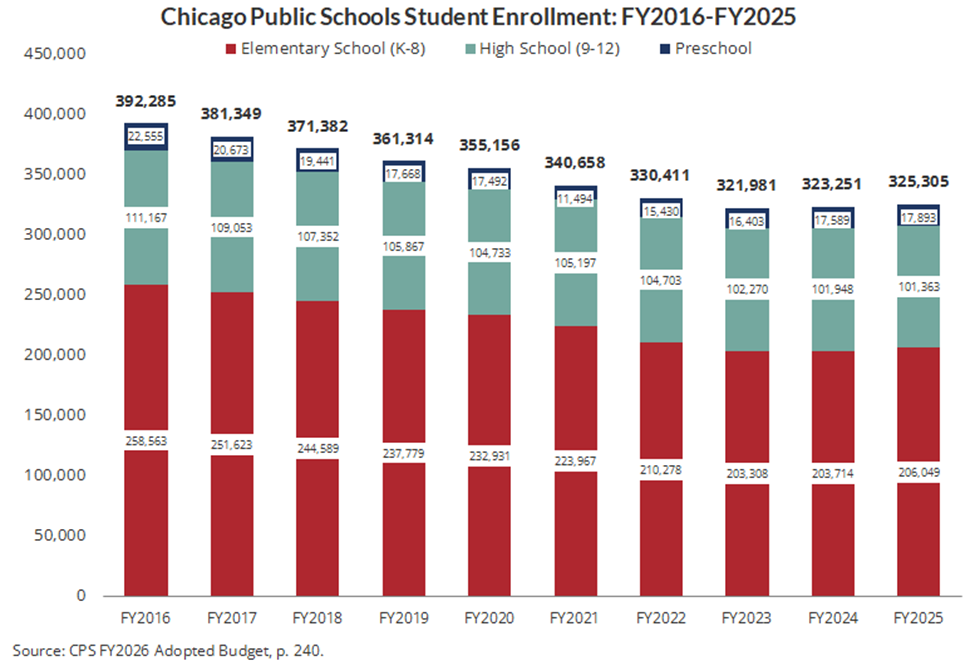
The CPS student population as a whole has faced consistent enrollment decline for decades, losing almost 60,000 students in the past decade. Enrollment was over 390,000 students in FY2016, while in FY2025 it was just above 325,000—an approximately 17% decrease.
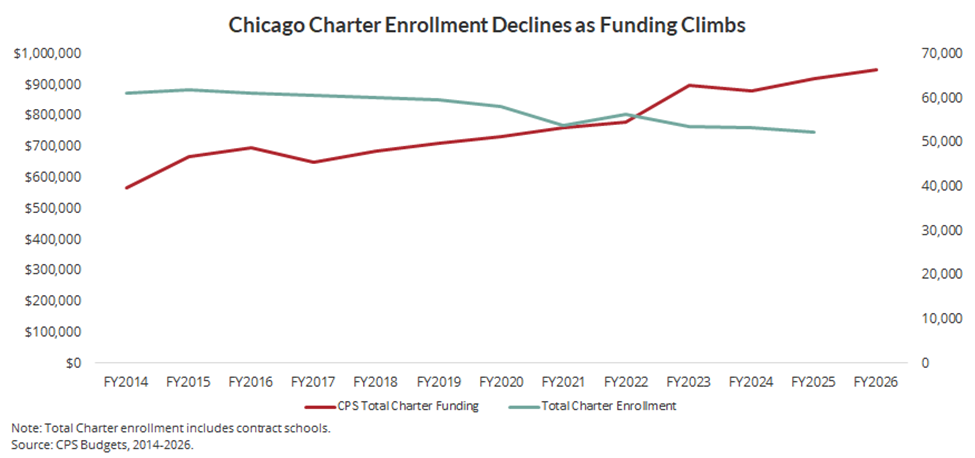
Charter schools have experienced a similar decline. In FY2016, charters in Chicago were at an enrollment of 61,114 students. But by FY2025, they were down to 52,333 students—a 14% decrease. Despite this, overall funding for CPS charters has climbed significantly in that time, much as funding for district schools has increased dramatically despite declining enrollment.
Charter School Closures
Charter school closures, sometimes announced mid-year, have become a routine occurrence within CPS in recent years. Sudden closures are upsetting for the students who attend closing schools and may be forced to move schools, as well as their families. These closures are also difficult for the district to manage. In each individual case of a charter school closing, CPS must decide whether to absorb the school into its network. If it chooses to do so, it must absorb significant costs, including teacher salaries, infrastructure, and maintenance expenses. If it allows the school to close, then it must redistribute the students among district schools if they choose to attend one.
Most recent charter closures are driven by falling enrollment. When a CPS district school sees its enrollment decline significantly, it does not see an automatic decline in funding from the district. Funding for district schools is largely not tied directly to student count, so declining schools are still able to fund their usual operations. However, each charter school or network operates on an island. Although most charters solicit private donations or federal grants, the majority of their funding still comes from their PCTC disbursements, which are directly tied to enrollment count. Thus, when enrollment goes down, funding also declines. When a charter school sees a significant enrollment decline, its assets drop below its liabilities, and it may be unable to cut costs enough to make up the difference, forcing it to close. Likewise, when a network of charter schools sees significant declines, it may be forced to close one or more schools to cut enough costs to make up for the lost revenue. Indeed, a review of recent voluntarily closed charter schools shows that most experienced significant enrollment declines in the years leading to their closure. The following series of charts displays the enrollment trends of charter schools or networks that have announced voluntary self-closures in recent years.
CPS Financial Oversight of Charter Schools
CPS’s primary lever for oversight over charter schools is the decision of whether or not to renew a charter’s contract at the end of its term. Illinois law gives CPS the authority to renew charters for contracts of up to ten years, but in recent years, CPS has largely issued renewals of two to four-year durations. When deciding whether and for how long to renew a charter’s contract, the District’s Office of Innovation and Incubation assesses student academic performance, financial stability, and compliance with state law and makes a recommendation to the Board of Education based on those metrics. Charter schools are only required to provide the district with this information when they are up for renewal, meaning that this is the only time that CPS formally receives updates on the fiscal health of charters.
The District’s assessment of a charter’s financial health is based on a combination of several different metrics. The District assesses the charter’s growth in assets, current asset to liability ratio, net revenue to assets ratio, and its cash on hand, all of which are indicators of its current financial stability. Finally, the District assesses whether the charter is delinquent on any of its loans and has successfully completed an annual audit. While these metrics are useful predictors of whether a charter is financially healthy in the moment—i.e., whether it is in danger of running out of money and being forced to close in the immediate future—only the growth in assets metric truly assesses the long-term fiscal health of a charter. A charter school that is seeing consistent declining enrollment (and thus declining revenue) may still have a positive asset-to-liability ratio, a strong amount of cash on hand, and be current on all loans, even if it is on track to fail those indicators in a couple of years.
The difficulty of assessing the long-term financial viability of a charter school is compounded by the volatility of enrollment, especially in the current environment of enrollment decline. Since CPS’ financial support comes on a per-pupil basis, if a charter school that is otherwise fiscally healthy suffers a sudden negative enrollment shock, it can see a significant decline in revenues, tipping it into an operating deficit. Recent enrollment declines increase the risk of a negative financial shock for many charters, which makes it difficult for CPS to project their long-term financial viability. This forces the District to rely on the present fiscal health of charter schools as indicators for their renewal for years into the future.
The existing charter school oversight regime creates several problems. First, charters are not audited regularly, nor are they required to submit annual documentation of their fiscal status. CPS only receives reports on a charter’s financial health during the renewal process. Since charters can see their fiscal status shift very quickly due to volatile enrollment trends, this means that CPS can easily miss the warning signs when a charter starts to decline. If the next renewal period is too far away, a charter can go under without the District having the information necessary to predict it in advance. This deprives the District of the opportunity to either help prevent the charter’s closure before it is too late or to prepare for the eventuality.
Even charters that appear fiscally healthy at the moment can see sharp enrollment declines, followed by fast declines in revenue. Since this can happen so quickly, CPS has tended towards shorter renewal periods in recent years, allowing it to more closely and frequently monitor the health of each charter. But renewal is an onerous process for both CPS and for charters. It requires hundreds of pages of paperwork to be submitted by each Charter, and the District must process dozens of renewal applications and financial assessments every year. Additionally, short renewal periods create uncertainty for charters, which can create inefficiency. For example, charters with short renewal periods are often unable to take on long-term building leases and are limited in their ability to make long-term investments in programs.
Policy Implications
Schools operate best and most efficiently when leveraging available economies. Operating a school or school district is a process that includes many large, fixed costs that remain high regardless of the number of students enrolled in the school. Administration, capital, and security are just some examples of costs that do not decline just because a school has fewer students, nor do they become more expensive if enrollment grows. This means that in an environment of falling enrollment, a school district’s cost per student will grow even if it does not expand operations or staffing in the way that CPS has in recent years. In Chicago, this problem is worsened by CPS’ struggles to address even its more flexible expenses. If a district loses thousands of students, it can partially compensate for the resulting climb in per-student costs by closing a proportionate number of facilities and reducing staff to meet the new, lower number of students. But the highly political nature of both decisions has caused the District and policymakers to shy away from school closures and staff reductions in recent years, even as enrollment has consistently declined.
In a system where charter school funding is allocated on a per-student basis, declining enrollment forces charters and district schools to compete for students. In Chicago, each additional student who enrolls in a charter requires CPS to pay thousands in per-student funding to the charter rather than spend those funds on its own district schools and administrative costs. While fewer students in neighborhood schools can reduce some of CPS’ operating expenses, high fixed costs and limited flexibility mean the District doesn’t save as much as it pays out on a per-student basis to charters. Enrollment declines also drive up per-student spending.
Conversely, when charter schools lose students, they lose the revenue needed to sustain operations. Their own fixed costs limit their ability to scale down spending, meaning enrollment losses can quickly undermine their ability to cover basic facilities, administrative, and staffing expenses. While this dynamic is inherent to the funding model, Chicago’s broader enrollment decline intensifies it: as the number of students shrinks but the number of seats remains constant, both charters and CPS are increasingly incentivized to draw students away from one another.
The recent increase in CPS spending on charter schools, driven by rising PCTC minimums, coupled with the sudden announcement of several charter closures in the last few years, has again catapulted Chicago’s charters into the political limelight. But the current situation with charters is best understood as an outgrowth of CPS’ broader struggles with declining enrollment and rising costs. Declining enrollment and the consequent higher per-student costs have increased PCTC for the district writ large while precipitating financial crises at individual charters that have seen their enrollment drop quickly.
Enrollment at CPS is likely to continue declining in the coming years. As per-student costs continue to rise, and the percentage of vacant classroom seats grows, the Board of Education and CPS administration will need to address the enrollment crisis head-on. When they seek to do so, charters should be a part of the conversation. Charter schools are not exempt from the challenges of enrollment decline, and their failures impact CPS in the form of higher costs and chaotic school closures. When the time comes for the District to consider rightsizing its facility usage, it will be more effectively able to do so if it considers charters alongside district schools, rather than treating them as a separate, unrelated issue.