

May 06, 2026
by Lily Padula
Executive Summary
Illinois is undertaking a significant governance change in early childhood policy by establishing the Illinois Department of Early Childhood (IDEC). The new department is intended to consolidate key early childhood programs currently administered across multiple state agencies, including the Illinois State Board of Education (ISBE), the Department of Human Services (IDHS), the Department of Children and Family Services (DCFS), and coordinating functions within the Governor’s Office of Early Childhood Development (GOECD), into a single cabinet-level agency. This shift reflects a broader national trend toward creating dedicated early childhood departments or offices intended to coordinate fragmented programs, streamline administration, and provide clearer system leadership.
This report examines how four peer states—Colorado, Massachusetts, New Mexico, and Oregon—structured and implemented similar early childhood departments. These states provide useful points of comparison because each established a standalone agency responsible for key early childhood programs such as child care assistance, licensing and regulation, and early learning or preschool. In each state, the creation of a dedicated department was intended to address fragmentation across agencies, simplify system navigation for families and providers, and strengthen policy coordination across programs serving young children.
Although the states share a broadly similar governance model, important differences exist in program scope, funding structures, and implementation timelines. In general, peer states consolidated child care subsidies, early learning programs, and licensing functions into the new departments, while leaving programs such as K–12 education, Medicaid and public health services, and child welfare in existing agencies. As a result, cross-agency coordination remained necessary for many services affecting young children and families.
Across the four states, implementation occurred through multi-year transition processes rather than immediate program transfers. States typically used formal transition councils, working groups, or external consultants to plan program transfers, map staff and funding streams, and address operational issues such as eligibility rules, procurement systems, and information technology infrastructure. Despite this planning, states reported similar implementation challenges, including disentangling programs from legacy agencies, maintaining stable payment and eligibility systems during transitions, integrating staff from multiple agencies, and aligning data systems and program rules.
Peer state experience also highlights that governance reform alone does not resolve broader structural challenges in early childhood systems. Workforce shortages, funding pressures, and uneven access to services continued to require policy attention after the new departments were created. While consolidation can clarify leadership and create a more coherent administrative structure, improvements in access, affordability, and outcomes depend on sustained funding, policy decisions, and administrative capacity beyond the initial organizational transition.
For Illinois, the experiences of Colorado, Massachusetts, New Mexico, and Oregon provide insight into the types of operational and administrative issues that often emerge when establishing a new early childhood department. The report therefore highlights key areas that are important for Illinois to monitor during IDEC’s transition, including operational stability in payment and eligibility systems; workforce capacity; cross-agency coordination, particularly at key transition points; and funding stability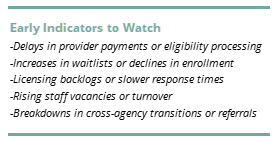 . Additional indicators include access and equity (enrollment, waitlists, and navigation), provider-facing systems such as licensing and technical assistance, data system integration, and the State’s ability to produce cross-program performance metrics. Over time, tracking child and family outcomes—such as kindergarten readiness, continuity of care, and disparities in access—will be important for assessing whether governance changes translate into improved results.
Illinois’ creation of IDEC places the state within a small group of “department states” that have chosen to organize early childhood programs under a single cabinet-level agency. As the transition unfolds, peer state experience suggests that the effectiveness of this governance reform will depend not only on the organizational structure itself, but also on how successfully the state manages implementation and uses the new department to coordinate programs, align policies, and track outcomes across the early childhood system.
This research was supported by the Robert R. McCormick Foundation. The Civic Federation is a nonpartisan, independent research organization, and the views expressed in this report do not necessarily reflect those of the Foundation.